

Gor blimey: swords, giant birds and an extremely dubious Counter-Earth (article).
There are fantasy series which age gracefully. There are fantasy series which become beloved period pieces. And then there is John Norman’s Gor, which has spent nearly sixty years squatting in a shadowy corner of the genre, dressed largely in leather and insisting that you address it as Master.
The extraordinary thing is that Gor did not begin as quite the literary spanking dungeon its reputation now suggests. The first few novels are perfectly recognisable examples of the old sword-and-planet tradition pioneered by Edgar Rice Burroughs. Take one educated Earthman, deposit him somewhere exotic, hand him a sword, surround him with princesses and improbable wildlife, then make absolutely certain nobody from the astrophysics department is allowed anywhere near the manuscript.
John Norman was the pen-name of John Frederick Lange Jr, an American philosophy professor with a Princeton PhD. This is worth knowing because, as the series progresses, Gor increasingly stops being simply an adventure story and becomes a philosophy lecturer who has somehow acquired a whip.
The first novel, Tarnsman of Gor, appeared in 1966. Its hero, Tarl Cabot, is an Englishman living in America who discovers that his missing father has not merely popped out for cigarettes. Dad is on Gor, a mysterious Counter-Earth occupying the opposite side of the Sun.
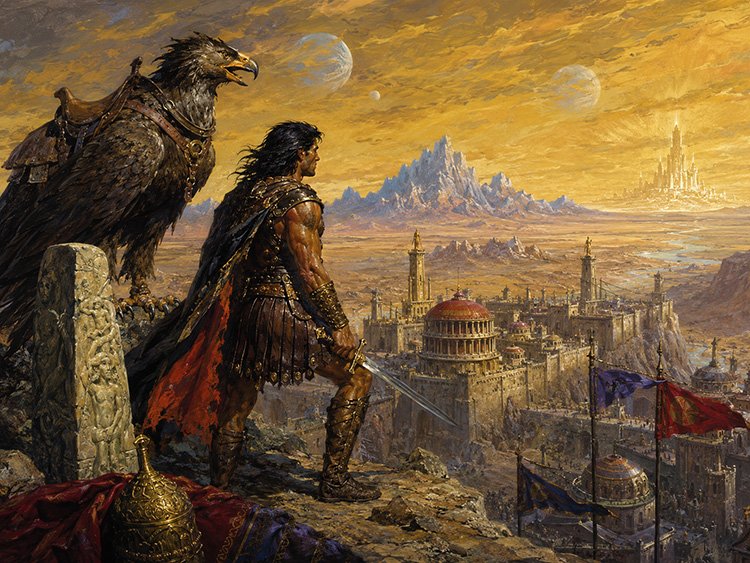
This arrangement is astronomically questionable in much the same way that keeping a dragon in your airing cupboard is questionable under most tenancy agreements, but never mind. Gor is there because John Norman says it is, and for sword-and-planet fiction that is traditionally sufficient paperwork.
Transported there, Tarl discovers a civilisation of city-states, warriors, slaves, merchants and giant predatory birds called tarns. These have wingspans large enough to carry people, allowing the Goreans to invent an air force without enduring the tiresome intermediate stage involving Boeing.
Tarl becomes a tarnsman and gets involved in the politics of cities such as Ar and Koroba. Much turns upon the possession of Home Stones, sacred objects representing the identity and sovereignty of a city. Stealing somebody else’s Home Stone is therefore roughly equivalent to nicking the Crown Jewels, the Magna Carta and Arsenal’s trophy cabinet in one afternoon.
And this is where early Gor is actually rather good.
Norman puts far more effort into his invented world than many of his sword-and-planet contemporaries. Gor has its own social classes, money, measurements, alphabets, festivals, food, clothing, military traditions, trading arrangements and political customs. He doesn’t merely build scenery. He checks whether the scenery has a municipal tax code.
The second book, Outlaw of Gor, sends Tarl back to discover Koroba destroyed and eventually deposits him in Tharna, where revolution is brewing. It is a stronger, more confident adventure novel, with the pleasures one expects from this corner of literature: swords, conspiracies, tyrants, escapes and enough abrupt changes of fortune to make Tarl Cabot’s life-insurance premiums genuinely terrifying.
Then comes Priest-Kings of Gor, arguably the most interesting of the early books.
Above Gorean civilisation lurk the Priest-Kings, mysterious beings dwelling in the Sardar Mountains. Most Goreans think they are gods. They are actually technologically advanced aliens who have deliberately prevented Gor from developing certain technologies. Build the wrong sort of machine and the Priest-Kings may remotely incinerate you, a system of technology regulation which Ofcom has so far resisted adopting.
When Tarl ventures into their domain, Norman does something rather better than simply producing humans with funny foreheads. The Priest-Kings are properly alien creatures with unfamiliar senses, instincts and methods of communication. Their society has its own logic rather than being Croydon Council with antennae. For a series generally remembered for women wearing considerably less clothing than workplace health and safety might recommend, this section contains some genuinely inventive science fiction.
Unfortunately, there is an elephant in the room.
Actually, by about book six there is an elephant in the room wearing a collar, and John Norman has written thirty pages explaining why it secretly enjoys being there.
The sexual politics of Gor become steadily harder to regard as incidental background. Slavery existed from the beginning, as indeed it did in many historical societies Norman borrowed from, but female sexual submission increasingly becomes not merely something occurring within the fictional culture but something characters spend considerable amounts of time philosophically defending.
Women are enslaved, stripped, branded and taught that submission to dominant men represents their true nature. Again and again, Norman returns to variations on the proposition that a supposedly independent woman will become happier once somebody puts a collar around her neck.
At this point the reader is entitled to cough politely and enquire whether we might possibly get back to the giant birds.
There is nothing inherently wrong with fiction exploring domination, submission or BDSM. Literature has wandered through far darker basements without needing the police called. The difficulty with later Gor is the sheer insistence of it. What begins as an element of an invented barbarian society gradually assumes the proportions of an authorial PowerPoint presentation. Characters stop merely having adventures and start explaining, at considerable length, why Gorean sexual hierarchy is right.
The books accordingly became notorious. They also became extremely successful. Estimates vary, but millions of copies were sold during their heyday in the 1970s and 1980s, and those painted paperback covers became familiar inhabitants of science-fiction bookshops. You might have gone in looking for Isaac Asimov and emerged wondering why half the neighbouring shelf appeared to be auditioning for employment in a barbarian nightclub.
DAW Books finally stopped publishing the series after Magicians of Gor in 1988. Norman maintained for years that ideological hostility had effectively blacklisted him. DAW’s Betsy Wollheim later gave her own remarkably forthright account, saying that she personally decided to stop publishing the books as their preoccupation with female slavery intensified.
That might have finished many series.
Gor merely went into hibernation.
Witness of Gor eventually appeared in 2002, and Norman continued writing. Remarkably, Treasure of Gor, published in 2024, is volume 38. Tarl Cabot has therefore enjoyed a longer literary career than many actual nations. Somewhere on Counter-Earth a very exhausted tarn is presumably demanding its pension.
The remarkable longevity points towards what makes the series fascinating even for readers who want nothing whatsoever to do with its sexual philosophy. Norman built a world with enormous depth. There are cities, cultures and competing peoples across Gor, while another major threat comes from the Kurii, technologically advanced predatory aliens who oppose the Priest-Kings. Beneath the ideological baggage lies an enormous planetary-romance setting that another writer could probably have mined for decades without ever once ordering somebody to kneel.
There were, inevitably, films.
Gor arrived in 1987, starring Urbano Barberini as Tarl Cabot, Rebecca Ferratti as Talena and, magnificently, Oliver Reed. It took Norman’s material and converted it into the sort of international fantasy production in which every available coin appears to have been spent on swords, smoke machines and hiring Oliver Reed.
Outlaw of Gor followed shortly afterwards, this time with Jack Palance joining proceedings. Neither film caused Peter Jackson sleepless nights. They are glorious examples of late-1980s fantasy cheese, full of bronzed warriors, improbable costumes and acting which occasionally appears to have been delivered while somebody just off-camera holds up a card reading MORE BARBARIAN.
The second film achieved a sort of immortality when Mystery Science Theater 3000 got hold of it. This may have been the natural endpoint of the entire cinematic project. If your fantasy film contains Jack Palance wandering around an imitation ancient civilisation while men in furry trousers fight each other, sarcastic robots are not merely likely. They are evolutionarily inevitable.
So should anyone still read Gor?
The first three books are certainly interesting historical specimens from the sword-and-planet tradition and considerably better than their later reputation might suggest. Priest-Kings of Gor in particular contains imaginative alien world-building which deserves to be remembered independently of Norman’s sexual hobby horse. Anyone fond of Burroughs, Leigh Brackett or the old planetary romances may find the early Gor surprisingly enjoyable.
After that, your tolerance for the series will depend heavily upon how often you are willing to watch an adventure novel put down its sword, clear its throat and begin another seminar on the natural condition of women.
Here at SFcrowsnest magazine, we have encountered some unusual fictional civilisations over the years. Gor remains one of the strangest, partly because Norman created such an elaborate and potentially compelling world, then increasingly filled the foreground with one enormous ideological obsession.
It is Barsoom with bondage, Sparta with spaceships, and a philosophy department which has somehow seized control of the costume budget.
But 38 books?
You cannot deny the man commitment.
Although on Gor, admittedly, denying the man anything may involve paperwork, a collar and an exceptionally long speech about Nietzsche.
