
Hugos in Anaheim, a Balrog voiced by Shaun of the Dead, and T. Kingfisher’s suspiciously good week (news roundup).
Somewhere in Anaheim this weekend, several thousand people who own more books than shelf space are shuffling between function rooms in a convention centre that also hosts dental conferences, and by Sunday night they will have handed out the most argued-over rockets in the genre.
LAcon V, the 84th World Science Fiction Convention, runs from 27-31 August at the Anaheim Convention Center, with the Hugo Awards ceremony arriving on Sunday 30 August at 8pm Pacific. This translates into a deeply unsociable 4am on Monday morning for those of us in Britain, so set the recorder, make the tea and later insist that, yes, of course you watched the whole thing live.
Mercifully, LAcon V is streaming the ceremony free on YouTube, with no convention membership required. This is either a triumph of fannish democracy or a cunning method of ensuring the arguments begin internationally before the winners have even reached the bar.
Guests of honour include Ronald D. Moore, who has previously demonstrated what happens when you take a 1970s cheese-fest seriously, remove most of the cheese and give everybody a body count.
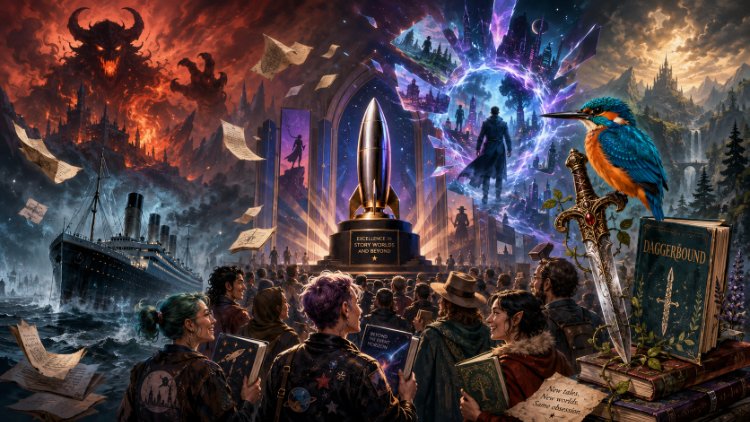
Presiding over proceedings as toastmaster is Ursula Vernon, better known to about half her readership as T. Kingfisher, which brings us neatly to the week’s most enviable piece of publishing synchronisation. Vernon has a new fantasy novel, Daggerbound, out on 25 August, five days before she stands on stage at the Hugos. If that is not one of the more efficient bits of publicity timing in modern publishing, it will do until something better turns up. One assumes the marketing department has been quietly weeping with happiness since roughly March.
The ballot itself has some proper meat on it. Nnedi Okorafor’s Death of the Author arrives in the Best Novel race already carrying the 2026 Locus Award for Best Science Fiction Novel, which is the awards-season equivalent of turning up to the pub quiz with a Wikipedia editor on your team.
Best Dramatic Presentation, Long Form has Andor season two squaring off against Guillermo del Toro’s Frankenstein and James Gunn’s Superman, a contest that rather neatly summarises the current state of screen science fiction and fantasy: prestige political thriller in space, an auteur finally making the monster movie he has been threatening for decades, and a man in a cape being sincerely nice to people. Stranger things have happened, although admittedly most of them occurred in Cleveland.
Best Game includes Hollow Knight: Silksong, a title that spent so long in development it acquired the status of an eschatological event, while Best Poem returns as a permanent category for only the second time in Hugo history. This is reassuring evidence that science fiction still has room for people attempting the difficult art of poetry for considerably less money than anyone sensible would accept.
Away from the trophy cabinet, the last week of August has been unusually generous to the bookshelves. Alongside Daggerbound, 25 August brought The Burn Line from Jonathan Sims, whose work on The Magnus Archives taught a generation that one of the scariest things in the world is a slightly tired man calmly reading out a witness statement.
M.K. Lobb’s The Dark in Her Veins, Rae Carson’s Monster, Monarch, Maiden and Donyae Coles’s The Sunken, the Adored all landed the same day, as did Elizabeth DeLozier’s The Whitechapel Full Moon Society, which sounds exactly like the sort of thing you read on a train before looking up nervously at the other passengers.
In the cheerfully absurd corner, M.H. Foster’s The Demon Overlord’s Retirement Plan concerns a demon overlord retiring to farm turnips. After the last few years, this is beginning to sound less like fantasy and more like a viable personal development strategy.
Two days later came M.K. Hardy’s The Haunting of Avis Lovelock from Solaris, in which a professional sceptic with a sharp tongue investigates supernatural happenings aboard a luxury ocean liner. Locked-room structure, period detail, creeping cosmic dread and nowhere to run because you are in the middle of the Atlantic: this is the sort of premise that has largely sold itself before the blurb has reached the second sentence.
Earlier in the month Adrian Tchaikovsky produced Preaching to the Choir from Solaris, Tim Pratt gave us The Jewel and the Comet from Angry Robot, and Chuck Tingle continued his improbable and now entirely respectable career as a horror novelist with Fabulous Bodies from Titan. Olivie Blake’s Dreamland arrived from Tor on 11 August.
Tchaikovsky, it should be noted, appears to publish more words per year than most people read. Here at SFcrowsnest we have begun to suspect that “Adrian Tchaikovsky” is actually a small writing collective operating from a bunker beneath Yorkshire.
On screen, Dark Matter returned to Apple TV+ for its second season on 28 August, with Joel Edgerton and Jennifer Connelly still cheerfully ruining one another’s lives across the multiverse.
The interesting wrinkle is that Blake Crouch’s novel has now run out. Season two therefore ventures beyond the book, meaning the adaptation is improvising in front of an audience that has read the source material and will absolutely tell everyone about it. Early reviews suggest the series has become more ambitious rather than less, which seems the correct instinct for a programme whose basic premise is essentially, “What if there were more of everything, including your problems?”
Looking further ahead, The Rings of Power returns for its third season on Prime Video on 11 November, dropping four episodes on day one before switching to weekly instalments.
The trailer unveiled at San Diego Comic-Con in July confirmed Simon Pegg as the voice of the Balrog, which is a casting decision of such magnificent left-field cheek that it deserves some manner of ceremonial plaque. Jamie Campbell Bower joins as Celeborn, while Eddie Marsan appears as Thrain.
Season three picks up five years after the fall of Eregion, with Sauron closing in on the One Ring. Expect brooding, betrayal, volcanic lighting, solemn declarations and more money visibly burning on screen than most national broadcasters possess in their annual drama budgets.
Finally, and on a more sober note, the genre lost John Crowley earlier this month at the age of 83.
Little, Big is one of those novels that admirers do not so much recommend as press into your hands with a peculiar expression and instructions to report back afterwards. Its reputation has only grown over four decades: a novel about a house, a family, a war involving fairies and the slow, sad, beautiful business of things receding beyond reach.
Crowley wrote fantasy that treated the form seriously as literature long before doing so became remotely fashionable, and the tributes since his death have been numerous and heartfelt.
If you have never read him, this would be a good week to start.
