

The Infinite State (The Decurion Saga book 1) by Richard Swan (book review)
‘The Infinite State’ by Richard Swan is the first novel in the Decurion Saga. This is a dystopian space opera about the impact of totalitarianism on normal people who are thrust or manipulated into trying to change things.
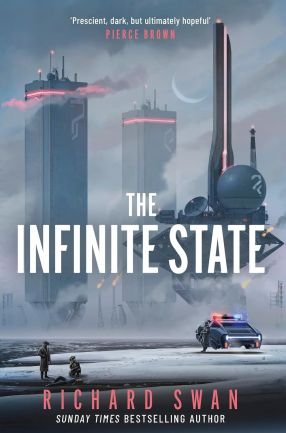
There are three main viewpoint characters, Katherine Fuller, Julian Yashego and Cyprian Reis. Each is impacted to their personal cost by the demands of Pater Aeternus, the Decurion empire’s dictator, via his government. This comprises power and information silos such as Ministry of the Interior led by Gerolf Morita, the Councillor General Chancellory headed by Ruben Morozov and Ministry of Information run by Jarosalv Droor. People in the empire are driven to be productive with one example is encouraging women to have as many children as possible.
Katherine and her husband, Eskil, are unlucky in being unable to have children naturally. Because he is head of Lamprey Corporation ITG and a party member, they had been allowed to attempt ectogenesis. A call comes in the middle of the night to come down to the clinic. There they are told their foetus, Gabriel, has become unviable because of a rare condition that is a sudden and irretrievable breakdown of nervous system.
On returning home, Eskil decides to go into the office. That is the last time Katherine sees him. His autocruiser sinks into the Marisole river, probably because it was pushed there by the downwash of a mega-spaceship launch.
Katherine becomes a very rich widow who does not know what to do with herself or the money. She needs to do something worthwhile. The idea of buying a planet to colonise was planted in her mind by Morozov. It grew on her as a way of escaping the oppressive surveillance state. She certainly has enough money to do so, money that Pater Aeturnus would not like to see leave the empire. However, bit by bit, with help from old and new friends she buys and starts colonising Gabriel. But this course of action is not without repercussions.
Julian Yashego is a hypersled racer from the planet Trillia, outside of the Decurion Empire. Yet being the best in the galaxy, he is hired for a season to represent Leonis, the empire’s capital planet. All goes well until his sled develops a problem that forces him to lose a race for the first time. It is won instead by Leonis’ former driver, Iakob Valéria, a Decurion who has a loyal set of supporters. Droor pressurises Julian to win the next race.
Valéria blackmails Julian about having sex with another male driver while on Leonis as it carries the death penalty. Julian asks Droor for help, which comes in dramatic form of making him publicly date and have sex with a woman and shooting Valéria himself at point blank range. But that is only the start of Julian’s problems with Droor, who has special plans for him.
The third viewpoint character is Inspektor Cyprian Reis of the Serious Crimes Bureau, who specialises in solving homicides. Sometimes, he is told they are sanctioned political killings, in which case he quietly closes the file without solving the crime. He cannot afford to do otherwise as he wants to get his children out of the government’s re-education programme, which is designed to make them compliant citizens of the empire.
A murdered body turns up that has had his identification tags removed. The body is so decomposed there is little expectation of identifying him. However, the dead man had a very rare liver disease: he is Verner Briseis, who was the chief engineer of the Leonis hypersled team until he went missing shortly after Julian lost his race.
Cyprian realises this is an unnotified sanctioned political killing and the case should be quietly closed. He finds a way to do so. His assistant, Lang, reports the irregular closure to the Inspektorate’s responsible minister, Morita. That is when Cyprian’s troubles really start.
The storylines converge towards the difficulties of colonising Gabriel and there are many.
I found myself in an unusual position on this novel. I grew up hearing the day-to-day stories of how my mother and her side of the family lived under the ruling Nazis in Germany. My reaction was that someone like Katherine would not have survived unscathed in such regimes. People who reached lofty positions in Germany knew they had to be circumspect about how they behaved in public. Katherine is already seen as a failure for not producing children in the Decurion Empire and she knows it. Therefore, she would have been instinctively doubly careful to come across as a model citizen. As it is, she moves from one blunder to another, such as keeping an illegal propaganda leaflet in her safe at home and talking a little too rashly when in a café with her friend. Despite her unusual imposed circumstances in ‘The Infinite State’, I just could not believe in her character.
Fortunately, the other two main characters, the idiot savant with a talent for piloting and the jaded weary fallen-from-grace detective come across much better.
The world-building is classic space opera and its technology ideas have been seen elsewhere in Science Fiction. It is familiar, comfortable and easily comprehended. This lets the modest Science Fiction reader focus on the characterisation and the plot.
The plot is there to convey a political message: tyranny can and should be fought against because it stops people achieving their best. This helps them overcome bad situations with the odds stacked against them.
‘The Infinite State’ is a blatant political treatise set as a space opera to help lens its message which is very much pertinent to our times today.
Rosie Oliver
August 2026
(pub: Gollancz, 2026. 405 page hardback. Price: £23.00 (UK). ISBN: 978-1-3996-2773-3)
check out website: https://store.gollancz.co.uk/products/the-infinite-state