

The Antikythera Mechanism by Charles Rivers Editors (book review).
Truth to tell, I still can’t pronounce Antikythera. However, I needed to do some research into a recognised astronomical device and thought The Antikythera Mechanism, sub-titled The History And Mystery Of The Ancient World’s Most Famous Astronomical Device, fitted the bill, especially as it was illustrated.
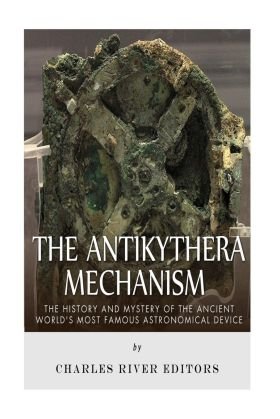
When you look at the cover above, it should immediately hit your memory’s recall button. Found in a shipwreck in the Ionian Sea, the mechanism was among a large number of objects brought to the surface and then largely ignored by archaeologists for more than two years. Left in the sun, its wooden casing cracked, revealing a system of wheels and gears inside.
Over the years, it has been repeatedly examined, and its purpose has gradually become clearer. In more recent times, extensive X-rays have allowed researchers to construct working replicas. The thing is, it dates from around the first century BCE, yet its gearing is extraordinarily advanced, and nothing else quite like it has ever been discovered.
What we have, then, is either a prototype made for a wealthy owner and lost at sea or something even stranger. The fact that it is now understood as a geared astronomical calculator, capable of displaying the movements of celestial bodies, still makes it unique. Search for comparable devices and you have to move forward many centuries before finding astronomical instruments of similar sophistication.
What this book does not do is spend much time asking how it was built or by whom. For the purposes of my next science fiction story, I’m suggesting that it was built by, or left behind by, a time traveller as a navigation tool. I’m not the first to think that, but in my case it is really just a throwaway line about what not to do when visiting the past.
Even so, you do have to wonder what other devices might be tucked away in museum archives because no one has yet investigated what they actually are. The fact that the Antikythera Mechanism was ignored for a couple of years before being studied tends to count against it being a hoax. The difficulty of making a convincing replica today only underlines how remarkable the original was.
Is it any surprise that we can only look at it and wonder?
GF Willmetts
July 2026
(pub: Charles River Editors, 2015. 38-page illustrated enlarged paperback. Price: varies. ISBN: 978-1-51970-613-3)
