

NASA has decided that gently pottering about in low Earth orbit is so last decade and has instead opted for a full-throttle, boots-on-the-Moon, reactors-glowing, paperwork-flying sprint into the future. At its “Ignition” event, the agency unveiled a plan that reads less like a policy document and more like the opening crawl of a particularly ambitious space opera.
The headline act is simple enough: get back to the Moon, stay there this time, and start building something that doesn’t look like it packs away neatly at the end of the mission. Not content with the occasional flag-planting jaunt, NASA now wants a proper lunar base, assembled in phases like some celestial IKEA project, only with fewer missing screws and rather more radiation shielding.
Phase One is essentially “try things and see what explodes, ideally not the expensive bits.” Expect a flurry of robotic missions, rovers trundling about like curious metallic beetles, and power systems that sound suspiciously like they belong in a Fallout game. Phase Two introduces semi-permanent kit and international guests bringing their own toys, including Japan’s pressurised rover. Phase Three is where it all gets serious: habitats, heavy infrastructure, and humans hanging about long enough to complain about the commute.
Meanwhile, the Artemis programme is being retooled into something resembling a production line rather than a series of heroic one-offs. Landings could happen every six months, which, if achieved, would make the Moon feel less like a distant dream and more like a slightly inconvenient business park.
Curiously, NASA is also putting the brakes on its Gateway space station in its current form. It’s not quite being jettisoned into the void, but the agency has clearly decided that if you’re going to build a house, you might as well focus on the ground floor rather than obsessing over the porch in orbit.
Back closer to home, low Earth orbit isn’t being abandoned to drift off like a forgotten sandwich in a school bag. The International Space Station gets a dignified nod as humanity’s long-running orbital laboratory, but the future lies in commercial stations. NASA’s plan is to nurture a bustling space economy, complete with private astronaut trips and a sort of cosmic Airbnb model, where NASA is just another customer popping by for a stay.
Then there’s the bit that makes engineers grin and health and safety officers reach for a stiff drink: nuclear propulsion. Yes, after decades of “maybe later,” NASA is planning to send a nuclear-powered spacecraft, charmingly titled Space Reactor-1 Freedom, to Mars before the decade is out. It will zip across the solar system using nuclear electric propulsion, which sounds like something a Bond villain would monologue about before being foiled by a man in a tuxedo.
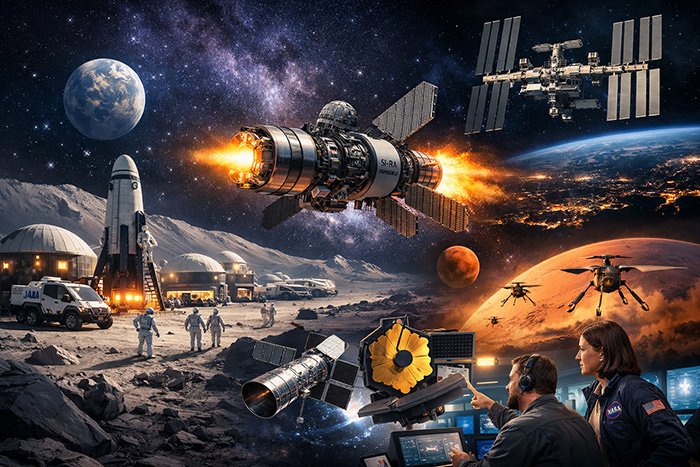
When it arrives, it will release a swarm of helicopter drones to buzz around Mars like inquisitive dragonflies, because apparently one helicopter wasn’t enough. Somewhere, Ingenuity is quietly feeling replaced.
Science, naturally, is along for the ride. The James Webb Space Telescope continues to peer back towards the dawn of time, while upcoming missions promise everything from dark energy sleuthing to nuclear-powered drones exploring Titan. There’s even a plan to let students and researchers hitch rides to the Moon, which is either wonderfully inspiring or the start of the most overqualified field trip in history.
And underpinning all this is a renewed focus on people. NASA wants its engineers closer to the action, its workforce bulked up, and its next generation ready to inherit the keys to the solar system. It’s a stirring sentiment, though one suspects the real test will be whether they can get all those committees to agree on where to put the coffee machine.
Here at SFcrowsnest magazine, we’ve seen plenty of grand space plans come and go, often filed somewhere between “ambitious” and “did anyone check the budget?” But there’s something undeniably compelling about this latest push. It has momentum, it has spectacle, and crucially, it has that slightly mad glint in the eye that says humanity isn’t done poking the universe just yet.
If even half of it comes off, the 2030s might look less like the future we expected and more like the one we were promised. Minus the jetpacks. Probably.

Join the conversation (0)