
Cities Are Forests Waiting To Happen by Cécile Cristofari (book review).
Cécile Cristofari is a new author. ‘Cities Are Forests Waiting To Happen’ is her second published book following ‘Elephants In Bloom’, which is the fifth volume in the ‘Polestars’ series and which won the 2025 British Fantasy Society Best Collection Award. Apart from this, Cristofari’s short stories have featured in several anthologies. Now she gives us ‘Cities Are Forest Waiting To Happen’, which is a novella of 128 pages. Regardless, this seems to be Cristofari’s longest work yet, so I suspect she is working up to grander things, such as a full-length novel or a series that explores more complex themes and narratives.
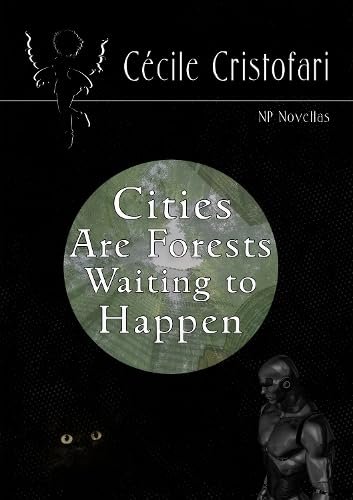
With a title like that, one might reasonably assume some kind of environmental apocalypse as the backdrop to the story, and Cristofari does not disappoint. The novella is set in Canada and immediately dates itself as being 164 years ‘post-apocalypse’. Two of the main characters reside on the coast, tasked with reporting destructive incoming storms to allow the inner cities ample time to prepare. Rossana is the elder, and we soon find out she is a famously experienced explorer. She now manages the outpost with her daughter, Catherine, who describes herself as a digital archaeologist.
This latter detail is important because Cristofari presents not one apocalypse but two. The ‘164 years post-apocalypse’ does not refer to environmental collapse but actually refers to a technological singularity, which is a hypothetical point in the future when artificial intelligences (AIs) suddenly gained sentience and went thoroughly rogue. In this context, we understand that AIs pose a significant threat wherever they emerge, as they often disrupt all forms of digital communication. As such, the human race has become dependent on much lower-tech methods of communication, such as analogue radio. Humans are even learning to understand whale speech, allowing the whales to transmit long-distance communications to humans. Alas, Cristofari does not dwell long on the topic of whale speech, which is a shame because, although it may seem wacky as a concept, it is quite attractive, much like Anne McCaffery’s dolphins. Cristofari has other priorities to attend to.
The other main character is Sabrina, who is working as a postgraduate on a research project to use an artificial intelligence program to understand and even predict chimpanzee behaviour. Sabrina’s story begins in the year designated as ‘Year 2 pre-catastrophe.’ Cristofari interleaves the chapters between the 164 post- and two pre-catastrophe settings, one after the other. Cristofari would not be the first author to tell a story this way, and, indeed, many fine authors have used similar devices, but, for this reviewer, the technique is off-putting. I like my stories to start at the beginning, proceed through them, and end at the end. However, I shall not hold this against Cristofari because, as I say, others have used this device before her.
It’s quite coincidental that the catastrophe leading to the apocalypse is AI-based and Sabrina is working on cutting-edge AI. The reader is expecting the two stories to tie together, and, indeed, they eventually do. There is a cute twist right at the end, but, alas, I feel Cristofari rather telegraphed the ending much earlier in the book, so I was not terribly surprised when it happened.
Cut back to the ‘modern’ 164 post-apocalypse setting, and we find Rossana summoned to explore an abandoned city to find a rogue AI. Catherine naturally accompanies Rossana, as her digital skills could prove useful. Their contact inland is a man named Ishmael whom Rossana immediately takes a prejudicial dislike to. Cristofari writes Rossana quite effectively here. As the story progresses and Ishmael turns out to be a fairly solid fellow, Rossana eventually realises she has treated him quite unfairly, and her reaction says more about Rossana than Ishmael.
It appears that the environmental collapse has driven many of the inlanders, as Rossana thinks of them, to a more agrarian culture. Images of shepherds grazing their sheep on the outskirts of cities largely reclaimed by nature are quite effective ones. However, it seems that genetically altered ivy has been deployed to stop the abandoned buildings from falling down. This initiative, in itself, seems to have gone somewhat askew, as the ivy seems to have grown out of all control, with some strains being very fast-growing indeed. This area is the environment that Rossana is famed for exploring in her youth, so it makes sense that she has been summoned to lead the quest to locate the servers the rogue AI is lurking on. Alas, this reviewer might have liked a bit more technical detail regarding this ivy-used-to-prop-up-buildings, as ivy’s natural binding is usually a double-edged sword with the ivy tending to cause structural failure of its support in time.
There is even a nice link between the ivy and the pre-apocalypse story, but I am happy to let the reader find the answer out, as this is slightly more surprising when it is discovered.
Overall, I found this book to share a common issue with most short stories, despite the competent writing in this novella. The result means that while there are some interesting ideas presented, they remain thoroughly undeveloped. The endpaper even features a nicely drawn picture of a whale, but whales are rarely mentioned in the book. The book feels like a missed opportunity. Maybe Cristofari has written about whales elsewhere?
Cristofari rightly focuses on the central stories and the character interactions therein. After all, the action is where the story really is. The post-apocalypse story is in most ways a straightforward enough quest, but the main protagonist, Rossana, at least goes through a development arc, albeit a short one. The historical pre-apocalypse story is actually more complex, with Sabrina interacting with her fellow researchers and balancing her work with her flatmate, who is initially very antagonistic to her but naturally holds hidden depth once we get to meet her properly.
Having previously been an author of short stories, Cristofari is flexing her longer-form creativity here. I would hope to encourage her, as the novel length would allow her to develop her attractive ideas a bit more. So, if you fancy a short read with some freshness, then this book is recommended well enough, but otherwise maybe keep an eye on Cristofari to see if any more substantive works might appear.
Dave Corby
March 2026
(pub: NewCon Press. 130 page A5 paperback. Price: £ 9.99 (UK), $11.99 (US). ISBN: 978-1-917735-06-7).
check out website: www.newconpress.co.uk