

Sam Neill, 1947–2026: Staying calm at the End of the World? (obituary)
Sir Sam Neill, the New Zealand actor who faced dinosaurs, Antichrists, alien dimensions, homicidal spacecraft and the occasional tentacled manifestation of marital collapse, has died at the age of 78. Neill died in Sydney on Monday 13 July 2026, surrounded by his family. His death was described by them as sudden and unexpected. Although he had previously been treated for stage-three blood cancer, his family confirmed that he remained cancer-free at the time of his death.
For much of the wider world, Neill will forever be Dr Alan Grant, the dry, practical palaeontologist of Steven Spielberg’s Jurassic Park. Yet for devotees of science fiction, fantasy and horror, he leaves behind something richer and considerably stranger: a gallery of rational men discovering, usually too late, that the universe has stopped obeying the regulations.
Neill’s particular genre gift was credibility. He could make the most outlandish premise feel temporarily plausible simply by looking at it with intelligent concern. Put Sam Neill beside a resurrected dinosaur, an invisible man, an Arthurian sorceress or a gateway to Hell and the audience instinctively accepted that somebody sensible was now dealing with the matter.
His first major encounter with screen evil came in Omen III: The Final Conflict in 1981, in which he played the adult Damien Thorn. It was a role that could easily have descended into operatic eyebrow work, but Neill gave Damien the polished assurance of a successful international businessman who happened to be the Antichrist. He was charming, controlled and quietly appalling, turning satanic power into something that might plausibly occupy a corner office.
That same year brought one of the most demanding and disturbing performances of his career in Andrzej Żuławski’s Possession. Neill played Mark, a husband returning to divided Berlin to discover that his marriage, his wife and perhaps reality itself were disintegrating.
The film remains a feverish mixture of psychological breakdown, body horror, political allegory and creature feature. Neill matched Isabelle Adjani’s volcanic performance with a descent of his own, beginning as an aggrieved husband and ending as a man almost hollowed out by jealousy, violence and metaphysical terror.
Genre cinema kept finding him. In John Carpenter’s Memoirs of an Invisible Man in 1992, Neill played David Jenkins, the calculating intelligence officer pursuing Chevy Chase’s transparent fugitive. The film was one of Carpenter’s lighter works, but Neill supplied a useful vein of menace. He was rarely required to shout in order to make a character dangerous.
Then came the role that transformed him into a permanent resident of popular culture.
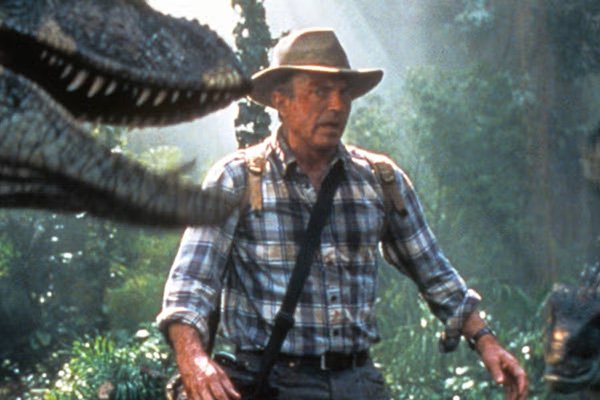
As Dr Alan Grant in Jurassic Park in 1993, Neill became the human anchor of a technological miracle. Grant begins the film more comfortable with fossils than children and understandably sceptical about a billionaire’s prehistoric theme park. After the fences fail, his academic reserve becomes courage, ingenuity and reluctant paternal affection.
Neill never tried to compete with the dinosaurs. He reacted to them. His expression upon first seeing a living brachiosaurus contained wonder, disbelief and the collapse of an entire scientific worldview. Later, pursued through the park by considerably less vegetarian specimens, he conveyed fear without surrendering intelligence. Grant survived because he watched, thought and adapted.
Neill returned as Grant in Jurassic Park III in 2001 and, two decades later, joined Laura Dern and Jeff Goldblum again for Jurassic World Dominion. Whatever the uneven fortunes of the films around him, Grant remained recognisably human: irritable, decent, courageous and permanently unconvinced that breeding giant carnivores was sound commercial policy.
The character became one of modern science fiction cinema’s most familiar heroes.
If Jurassic Park made Neill a global star, John Carpenter’s In the Mouth of Madness in 1994 gave him one of his finest genre roles. He played insurance investigator John Trent, dispatched to find missing horror novelist Sutter Cane.
Trent begins as a professional sceptic, confident that every apparent mystery conceals a fraud. He ends inside a reality rewritten by fiction, laughing in a cinema as he watches his own destruction projected back at him.
Neill’s performance is the mechanism by which the film turns. His urbane disbelief gradually fractures into panic, rage and finally lunatic acceptance. Carpenter needed an actor capable of taking cosmic horror seriously without becoming solemn. Neill understood that the end of reality could be both terrifying and horribly funny.
Three years later he boarded the Event Horizon, one of science-fiction horror’s most notorious lost ships. As Dr William Weir, designer of an experimental gravity-drive vessel, Neill initially appears to be the familiar scientific authority figure. Unfortunately, his ship has travelled somewhere beyond conventional space and returned with a taste for psychological torture.
Event Horizon was not warmly received on its original release, but grew into a substantial cult favourite. Neill’s transformation from grieving scientist to mutilated emissary of the ship’s infernal dimension provides its most indelible image. His calmness curdles into fanaticism as Weir concludes that the darkness awaiting humanity is not something to escape, but something to embrace.
Between these darker voyages, Neill also became Merlin in the lavish 1998 television miniseries and returned for Merlin’s Apprentice in 2006. His Merlin was less a glittering storybook wizard than a weary survivor of old powers and older mistakes.
The performance earned Neill both Emmy and Golden Globe nominations and demonstrated his ability to give mythic material emotional weight.
His other genre work sprawled cheerfully across the map. He appeared in the Gothic fantasy Snow White: A Tale of Terror, played the patriarch of a robot-owning family in Bicentennial Man, confronted ancient subterranean creatures in the New Zealand adventure Under the Mountain, and became the vampiric industrialist Charles Bromley in Daybreakers.
He lent his voice to Legend of the Guardians: The Owls of Ga’Hoole, appeared in the supernatural television miniseries The Triangle, investigated temporal mysteries in Alcatraz and turned up briefly but memorably in Invasion.
Marvel recruited him to play an Asgardian actor impersonating Odin in Thor: Ragnarok and Thor: Love and Thunder, a joke improved by Neill performing it with complete theatrical dignity.
His extensive genre credits also included The Adventurer: The Curse of the Midas Box, The Portable Door, Rick and Morty and several Jurassic World video games.
Even at the end of his career, the monsters had not finished with him. Neill had completed work on Godzilla x Kong: Supernova, due for release in 2027, ensuring one final appearance in a world where prehistoric giants once again make a compelling case against reckless scientific experimentation.
Away from genre, Neill’s career encompassed My Brilliant Career, Dead Calm, The Hunt for Red October, The Piano, The Dish, Peaky Blinders and the gloriously humane Hunt for the Wilderpeople.
He could play romantic leads, compromised husbands, spies, policemen, kings, farmers and eccentrics without appearing trapped inside any of them. Across more than five decades and over 150 screen roles, he remained one of the most dependable and versatile actors produced by New Zealand and Australian cinema.
But science fiction and horror made especially good use of him because Neill carried civilisation around with him. He looked as though he believed in reason, good manners and the desirability of keeping the dimensional portal securely closed. That made it all the more effective when madness, magic or monsters finally breached the perimeter.
Sam Neill could stand before the impossible and persuade us that it was really there. Then he would take off his hat, study it carefully and prepare to run!
