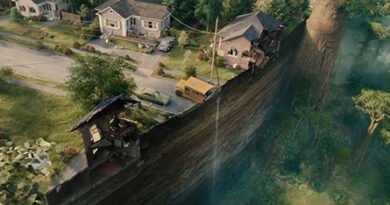

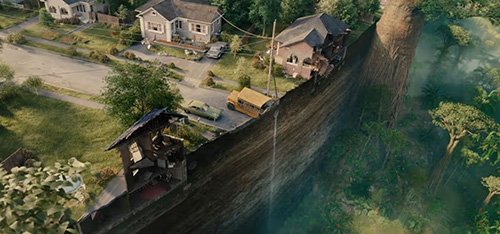
The End of Oak Street: when your quiet suburb time-slips (trailer).
There is something faintly sinister about suburban streets at the best of times. Too neat. Too tidy. Too many identical bins lined up like they’ve signed a quiet agreement with the universe. So it feels only right that science fiction should eventually turn its attention to the idea that one day, your entire neighbourhood might simply… go somewhere else.
Enter The End of Oak Street, David Robert Mitchell’s latest foray into the unsettling, which takes the humble cul-de-sac and asks a deceptively simple question: what if your street woke up one morning and found itself no longer attached to reality?
The setup is deliciously low-key. No grand alien invasion. No flaming meteors announcing themselves with dramatic orchestral flourishes. Just a family, a street, and the creeping realisation that something is very, very wrong. The sort of wrong that starts with odd little details, a flicker here, a strange absence there, and then quietly escalates until the entire world has slipped its moorings and drifted off into the cosmic unknown like a shopping trolley with ambition.
Anne Hathaway and Ewan McGregor anchor the film as Denise and Greg, a couple who suddenly find that the most pressing issue in their lives is no longer bills, schools, or whether the neighbours are judging their recycling habits, but the small matter of survival in a place that does not appear on any map, celestial or otherwise. Around them, their children (played by Maisy Stella and Christian Convery) must adjust to the sort of coming-of-age story that involves less homework and more existential dread.
Mitchell, whose previous work has demonstrated a fondness for slow-burn unease and the kind of horror that creeps up behind you and taps you politely on the shoulder, seems an ideal fit for this premise. If the trailer is anything to go by, The End of Oak Street is not interested in loud spectacle so much as quiet dislocation. This is science fiction that whispers rather than shouts, the cinematic equivalent of realising your house key no longer fits your own front door.
The real hook, though, is the idea of isolation. Not the grand, heroic isolation of astronauts drifting through space, but the much smaller, more intimate kind. A handful of families, cut off from everything they know, forced to rely on each other in an environment that doesn’t obey the rules they grew up with. It’s The Twilight Zone by way of a neighbourhood watch meeting, with added cosmic horror lurking just beyond the hedges.
One suspects the film will have a fair bit of fun with the breakdown of suburban order. The carefully maintained lawns, the polite small talk, the unspoken hierarchies of who owns the nicer barbecue. All of it becomes rather irrelevant when the sky itself refuses to behave. There’s a certain poetic justice in watching the most controlled environments unravel first, as if the universe has decided that symmetry and routine are simply too tempting a target.
Behind the camera, there’s some serious pedigree at work. With Bad Robot involved, there’s a hint that things may not remain entirely small-scale for long, while Michael Giacchino’s score promises to add that familiar mix of wonder and unease, the musical equivalent of staring into the unknown and deciding it might be staring back.
The title change from Flowervale Street to The End of Oak Street also suggests a shift in tone. The former sounds like a pleasant place to visit. The latter sounds like somewhere you might not leave. It’s a subtle but telling tweak, and one that hints this may not be a story that wraps up with everyone cheerfully returning home in time for tea.
Of course, the big question is what exactly has happened to Oak Street. Science fiction thrives on that tension between explanation and mystery. Reveal too much, and the magic evaporates. Reveal too little, and you risk leaving the audience feeling like they’ve wandered into someone else’s dream halfway through. Mitchell’s track record suggests he’s quite happy to leave a few questions hanging in the air, gently rotating, just out of reach.
Here at SFcrowsnest, we’re always partial to sci-fi that takes the familiar and gives it a quiet twist of the knife. The End of Oak Street looks poised to do exactly that, turning the everyday into something uncanny, and reminding us that the most unsettling journeys are often the ones that begin right outside your front door.
So next time you step out onto your street, have a quick look around. If the houses seem a little too still, the sky a little too wrong, and your neighbour Dave is acting even more suspiciously than usual, it might be time to check whether Oak Street has decided to go on holiday without you.
And if it has, do remember the golden rule of suburban survival: always bring the good biscuits. You never know what dimension you’ll need them in.