

LifePods: Escape From New York, but make it French and invoiceable (news).
LifePods appears to be one of those rare gadgets where the design meeting may have begun with someone slapping a VHS copy of John Carpenter’s Escape From New York on the table and saying, “Oui, but what if Donald Pleasence had landed somewhere with better after-sales support?”
The French firm Momentum Technologies is pushing LifePods as a range of portable protection capsules for extreme events: floods, fires, armed threats, explosions, tsunamis, seismic unpleasantness, and presumably the moment your smart fridge joins a militia. The company’s own pitch describes them as autonomous shelters engineered in Europe to give people a temporary refuge when ordinary infrastructure has gone full dystopian blancmange. The official blurb talks of sealing the hatch in around ten seconds, thermal and impact protection, integrated CO2 scrubbers, active signalling and up to 72 hours of breathable-air autonomy. In other words, it is less “garden shed” and more “panic room after watching too much TF1 and then investing in welding.”
There are various models in the pipeline. The B-01 is the land-based version, a ballistic and fire protection capsule aimed at armed attacks, explosions, fires, schools, sensitive sites, law enforcement and other places where the phrase “risk assessment” has acquired fangs. The W-01 is the floating model, designed for rapid submersion, waves and water surges, complete with harnessed seats, stabilisation systems and the sort of visual presence that says: “Do not worry, rescue drone, I am the huge survival lozenge bobbing over here.” A Q-01 seismic version is also proposed, because hiding under the table is all very well until the table was purchased from a flat-pack warehouse and has the load-bearing confidence of a nervous biscuit.
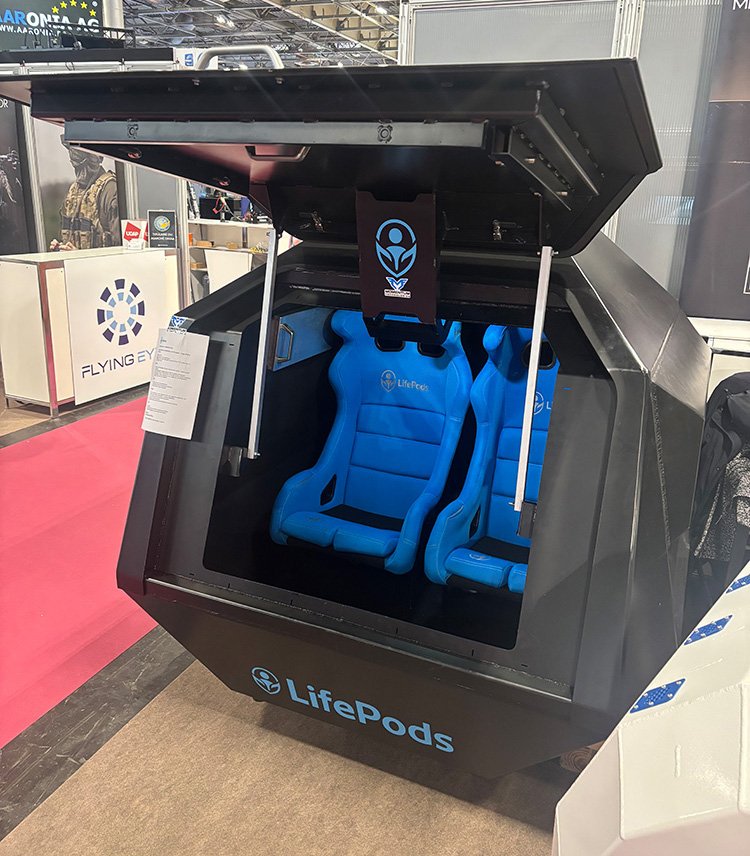
Naturally, what caught our genre-soaked eyes here at SFcrowsnest was the alarming resemblance to the escape capsule used by President John Harker, played by Donald Pleasence, in Escape From New York. In Carpenter’s 1981 film, Air Force One is hijacked, the President is popped into an escape pod, and the pod lands in the worst possible bit of future Manhattan. This is what happens when procurement specifies “survive plane crash” but forgets to add “avoid landing in maximum-security urban war kingdom ruled by Isaac Hayes.” Entertainment Weekly recently pointed out that the whole Air Force One escape pod idea is a grand bit of cinematic nonsense, but one that has lodged itself in the public imagination like a rivet in Snake Plissken’s boot.
LifePods, however, are not presented as film props. They have been doing the serious trade-show circuit, with Momentum Technologies showing the capsules at VivaTech and Eurosatory 2026, where the B-01 and W-01 were pitched as mobile survival infrastructure rather than underground bunkers with delusions of grandeur. New Atlas reports that the B-01 is built for bullets, blasts and fire, while the W-01 is intended for floods, tsunamis and marine immersion, with the company aiming more at institutions, emergency operators, security buyers and infrastructure clients than at your average suburban homeowner who has watched one too many apocalypse documentaries.
The pricing is not exactly “impulse buy beside the barbecue charcoal”, either. The company page seen by us listed €26,000 VAT included for the B-01 and W-01 showcase models, and €18,000 for the proposed Q-01 seismic capsule, while New Atlas gives higher indicative figures for later positioning, including €29,000 for the B-01 in France and €35,000 to €40,000 ex-works for the W-01. Either way, you are somewhere between “small car” and “please do not tell the accountant this is for climate resilience and not because I want to pretend to be Donald Pleasence.”
The sensible note, before we all start decorating our gardens with flood-proof presidential eggs, is that much of this still lives in the land of prototypes, tests, claims and scheduled certifications. Momentum says ballistic panel tests have validated VPAM PM7 level protection, but New Atlas notes that final full-capsule validation still matters because a bullet-resistant panel and a complete survival pod are not the same thing. One is a material achievement. The other is a metal womb that must keep you alive while the world outside auditions for a disaster movie.
Still, there is something profoundly science fictional about all this. Not because the technology is impossible, but because it feels like one of those background props in a 1980s future-noir film that would sit unnoticed until the director needed to explain how the minister, monarch or suspiciously calm CEO survived the orbital strike. The LifePod is not glamorous. It is not a flying car. It does not promise immortality, uploaded consciousness or a robot butler with unresolved legal status. It promises a door, a shell, air, signalling, and time. Which, in most disaster scenarios, is considerably more useful than a cyberpunk leather coat and a brave attitude.
Whether LifePods become a serious civil-protection niche or end up as trade-show curiosities for the fortified-lifestyle crowd remains to be seen. But the visual comparison is irresistible. Forty-five years after Carpenter gave us a presidential escape egg and hoped nobody would ask too many engineering questions, a French company has arrived with something that looks ready to roll across a flooded boulevard, blink at a rescue drone, and mutter in a clipped diplomatic voice: “Snake Plissken? I thought you were dead.”
