

Gods, Cider and the Fine Art of Doing Less: A Friday at the Idler Festival 2026 (convention report).
There are literary festivals that feel suspiciously like science fiction cons with better scarves and bush hats. Then there is the Idler Festival, where one can sit beneath an apple tree drinking cider, listen to folk music, contemplate the proper use of philosophy and be lobbied by an assortment of unemployed ancient gods.
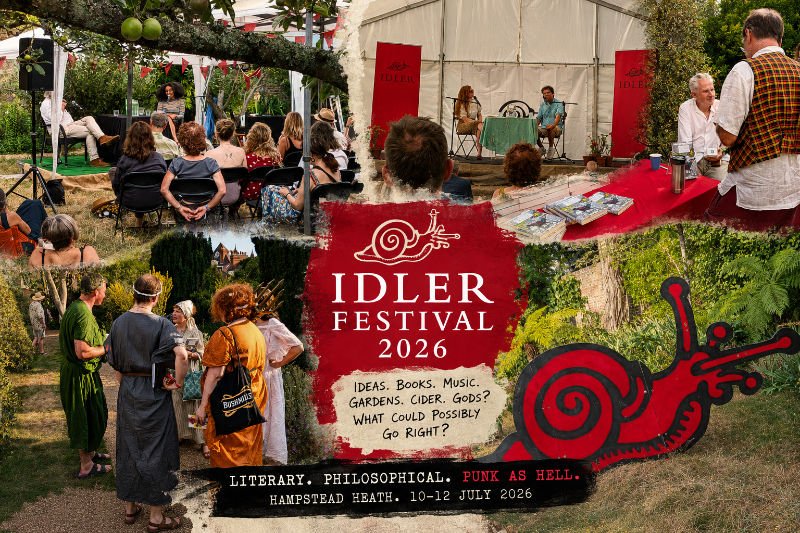
I visited the festival yesterday on Friday evening at Fenton House and Gardens in Hampstead, a wonderfully civilised setting for an event devoted to philosophy, books, music, merriment and the radical possibility that life should contain rather more life and rather less frantic administration.
My first talk was How to Live Like a Stoic, with Idler editor Tom Hodgkinson in conversation with Florence Read. Stoicism has lately suffered the strange fate of being rediscovered by men on YouTube who appear to own twelve protein shakers and believe Marcus Aurelius was chiefly concerned with personal branding.
The modern “grindset” version of Stoicism generally runs something like this: rise at four in the morning, take an ice bath, silence your emotions, dominate the marketplace, buy an unnecessarily aggressive car and eventually acquire enough material possessions to prove that material possessions do not matter.
Hodgkinson’s argument was that this rather misses the point.
The ancient Stoics were not preaching emotional constipation in the service of increased productivity. Nor were they developing a classical self-help programme for aspiring cryptocurrency barons. Their philosophy was stranger, more humane and considerably more radical than its online appropriation suggests.
The object was not to endure hardship merely so that one might accumulate a larger heap of expensive rubbish. It was to understand which things are genuinely within our control, to loosen our dependence on status and possessions, and to cultivate a life that cannot be wrecked whenever fortune changes the seating plan.
In other words, the Stoics would probably regard the frantic pursuit of watches, supercars and “passive income” as evidence that the pupil had failed the introductory module.
This was followed by Finding Albion, in which writer, broadcaster and DJ Zakia Sewell discussed her new book with John Mitchinson. Sewell has travelled through Britain in search of a country beneath the official one: a landscape of folk songs, seasonal rites, local legends, stone circles and stranger currents that survive outside the usual national pageantry. Her Albion is less flagpole and more half-remembered song carried across a field at dusk. One of the most interesting ideas to emerge was that many traditions we casually describe as ancient are not nearly as ancient as we imagine. Folklore is rarely a perfectly preserved message arriving intact from the Bronze Age. It is patched, reinvented, misremembered, revived and occasionally fabricated by energetic Victorians with excellent beards.
Rather than treating this as a disappointment, Sewell suggested that we might take it as permission. Perhaps we should create traditions of our own. Not fake heritage manufactured by a tourism board, but rituals with some local meaning, communal spirit and wildness in them.
Modern life is not short of scheduled activities, branded experiences or online content. What it lacks is mystery. We have become very good at organising events and rather poor at summoning occasions.
The festival itself seemed determined to correct this deficiency. Throughout the evening, a collection of wannabe deities roamed the gardens, persuading visitors to support their elevation to Olympus. Each represented some contemporary power or affliction, including gaming and misinformation, and festivalgoers cast their votes by dropping pebbles into jars.
It was American Gods reimagined by a parish council with access to theatrical costumes.
The performers approached their divine election campaigns with admirable zeal. Unlike ordinary politicians, they openly admitted to embodying dangerous forces and confined their voter manipulation to pebbles. Zeus and Athena, apparently concerned about staffing levels, were prepared to admit one more god to the celestial establishment.
Around all this were wandering musicians, folk tunes, garden conversations and the soft anarchy of people sitting beneath apple trees with cider. There was a pleasing looseness to the festival. One could move from ancient philosophy to reconstructed folklore, pass a campaigning deity near the shrubbery and then settle in the orchard while folk music drifted through the evening.
It felt less like attending a programme and more like wandering into a particularly literate alternate England.
Naturally, I bought hardback copies of both How to Live Like a Stoic and Finding Albion, and had them signed by their authors. This made a pleasant change from sitting behind a table myself, signing books for a long queue and discovering exactly how many repetitions of one’s own name are required before the wrist begins sending formal complaints to management.
Sadly, I attended only the Friday programme. Saturday, today, includes Cory Doctorow discussing Enshittification, his study of how online platforms steadily make themselves worse while extracting ever more value from their users. The title alone deserves preservation in the British Library, preferably engraved above the entrance to several large technology companies.
Sunday’s programme tomorrow includes Nigel Planer, eternally remembered by many of us as Neil from The Young Ones, discussing a creative career that has continued through acting, novels, plays and poetry.
Missing both feels rather against the spirit of idleness. Surely the proper course would have been to remain in the orchard for the entire weekend, nourished by cider, philosophy and occasional divine lobbying, until politely removed by the National Trust?
And for a few hours in Hampstead, doing less felt remarkably productive.
(FYI, If you’re free today or tomorrow, you can still get a day ticket at https://www.idler.co.uk/festival/)
Stephen Hunt is a best-selling science fiction and fantasy author with HarperCollins/Hachette/Tor, founder of SFcrowsnest, recovering steampunk, and University staffer, who can usually be found lurking somewhere between a bookshop, a cinema and the nearest decent cider orchard.
Explore more:
The Worlds of Stephen Hunt
Stephen Hunt’s Indie Bookstore
Science Fiction & Fantasy on Facebook
Steampunk on Facebook
