
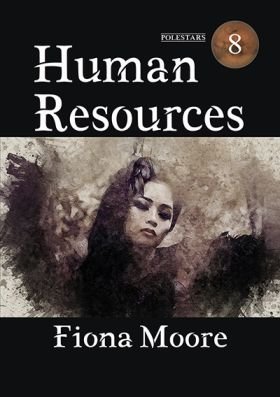
Human Resources (Polestars 8) by Fiona Moore (book review).
‘Human Resources’ is the eighth volume in the ‘Polestars’ series, which showcases anthologies. Each volume focuses on a different author; in this case, Fiona Moore. She is a diverse author with not just her novel ‘Driving Ambition’ and many short stories but also several volumes of SF television criticism and much stage and audio work. Clearly, Moore is a good pick as a ‘Polestars’ author because her work is spread out diversely and may be hard to collect. Therefore, this anthology is a welcome addition to that range.
If there is a theme that comes through, then it is that Moore has a habit of looking at classic films, TV or events of the past and then asking what the natural consequences of that would be in the modern day. It is easy to see how this would relate to Moore’s extensive criticism of TV, which is obviously close to her art.
For example, the tale named ‘Doomed Youth’ is obviously related to the seminal 1954 film ‘Them!’, which posits that nuclear testing results in overgrown ants turning on American citizens. Moore’s story looks at urban America decades later, when most people accept the ants’ existence and try not to disturb them.
Similarly, ‘Leave Only Footprints’ looks to see what modern America might be like following the events of the 1956 movie ‘Earth Versus The Flying Saucers’. In this story, students are being guided around the abandoned Smithsonian Institution in Washington DC, which was devastated decades previously by flying saucers. Both of these stories feature energetic writing which manages to deftly leave the reader with a sense of impending terror while not overstaying their welcome.
It is probably worth noting here that Moore provides a bit of explanatory text at the end of each story. This tells the reader Moore’s inspiration, maybe if it is an early story or intended as part of a larger work, for example. Sometimes these asides can be quite illuminating, and, at other times, the reader finds themselves thinking, ‘Well, duh,’ as the story might have been self-explanatory enough not to need the extra information.
Some of these stories are related to each other much as if they are chapters in a book, such as ‘Push A Little Button’ and ‘Every Little Star’. These both focus on Captain E. Artemesia ‘Artie’ Quelch, formerly Ace Girl Pilot, which Moore herself describes as ‘Captain Scarlet, but they’re lesbians’. Indeed, there is a high degree of embracing the rainbow of DEI in these stories. Moore manages to avoid the salacious details or bashing the reader over the head with pansexuality. The character’s relationships are not really the main point of any of the stories; they just so happen to be the way they are as part of the background colour.
‘Mnemotechnic’ is interesting, as it posits that a digital singularity was reached and humans have abandoned digital computers. Instead, we have human beings tested for mnemotechnic training at a young age. If they pass the grade, they are required by law to train as a computer. Once they have trained their memory to store information and draw correlations, they are employed by corporations, etc., to do the necessary financial, legal and whatever processing is needed. The actual story features a talented computer named Tony, who has been punished in the past for illegal processing. Contacted by a shadowy group, can he redeem his situation? To be honest, I found myself thinking that Moore missed a trick in this story, as the computer singularity was clearly the Y2K scare, but Moore doesn’t define it as such.
My self-satisfaction at noticing this did not last. The story ‘Human Resources’, which gives this volume its own title, is clearly another tale set in the same world with the human computers. However, this time Moore directly references Y2K as the disaster that gave rise to the slightly Mentat-like situation. This reviewer must admit that I am old enough to have been responsible for preparing certain systems for the assumed threat of Y2K and remember how much of a damp squib it was, and so the catastrophe leader to Moore’s setup does feel something of a non-starter.
Several of the stories either feature as their setting or directly reference Toronto’s gay village. Moore reveals that she worked there for a while and likes to bring in real-world elements. It is also another fine way to bring that rainbow back in without making it too integral to the actual stories.
This volume includes some nineteen short stories, ranging from a few pages to maybe twenty sides for the longer ones. With the exception of one or two, they almost all give the reader the odd sense that Moore is making seemingly obvious observations stemming from past film or television, which honestly feel a bit redundant. However, on deeper introspection, I cannot recall any other author managing this trick on such a successful basis, and so I guess this represents a certain kind of genius? The type that looks askew at things like 1950s cinema and sees consequences no-one else has done. Very clever.
If this kind of thing attracts you, then I am happy to confirm that Moore writes competently with a deft level of skill. In terms of pure fiction, Moore seems to have focused on the short story form, so I assume this volume is a good way to dip your literary toe into her work. It is certainly a characterful volume that will leave some of its visions lodged into your mind for years to come.
Dave Corby
January 2026
(pub: NewCon Press. 274-page small enlarged paperback. Price: £13.99 (UK). ISBN: 978-1-914953-76-7).
Check out the website: www.newconpress.co.uk.